Feb 2, 2026
Web Design
Think about the last time you shopped online.
You probably opened a few tabs, compared prices, skimmed reviews, filled out forms, and double-checked your payment details. We’ve all done it. And for years,UX design has spent decades trying to make this process smoother, faster, and less frustrating.
Agentic commerce is advancing from this track. Instead of asking you to do all the work, agentic commerce lets AI agents act on your behalf, from finding the right product to managing what happens after you buy it.
This raises a fundamental question for UX and web teams:
What does user experience mean when the “user” is an AI agent acting in someone’s interest?
Come on, let’s dive in and explore more about it.
What Is the Agentic Commerce Protocol?
The Agentic Commerce Protocol (ACP) is a set of technical standards that allows AI agents and commerce systems to communicate securely and consistently.
In simple terms, ACP defines how an AI agent understands, negotiates, and completes a transaction on a user’s behalf, without relying on traditional web pages or manual checkout flows.
It enables AI agents to:
Share user intent with merchants
Read structured product data and availability
Evaluate pricing and policies
Initiate and complete purchases securely
How Agentic Commerce Works and Why Protocols Matter
Agentic commerce is about letting AI handle shopping tasks for us. Instead of people manually searching, comparing, and checking out, AI agents can do much of this work on their own, with little or no human involvement.
These AI agents understand user goals expressed in simple language. For example, you simply express your goal in everyday language: “Find eco-friendly running shoes under $120.” The agent then:
Searches across multiple stores
Compares options and prices
Checks availability and delivery
Makes a purchase decision based on your preferences
In many cases, this entire process happens without you ever visiting a website or filling out a checkout form. The experience feels less like shopping and more like delegating a task to a trusted assistant.
This shift is already happening in real products. Tools like OpenAI’s Instant Checkout and Microsoft’s Copilot Checkout allow users to search for products and complete purchases directly within a conversational interface. Instead of browsing multiple sites, users can simply talk to an AI, and the buying happens in the background.
Why Agentic Commerce Is a UX Turning Point
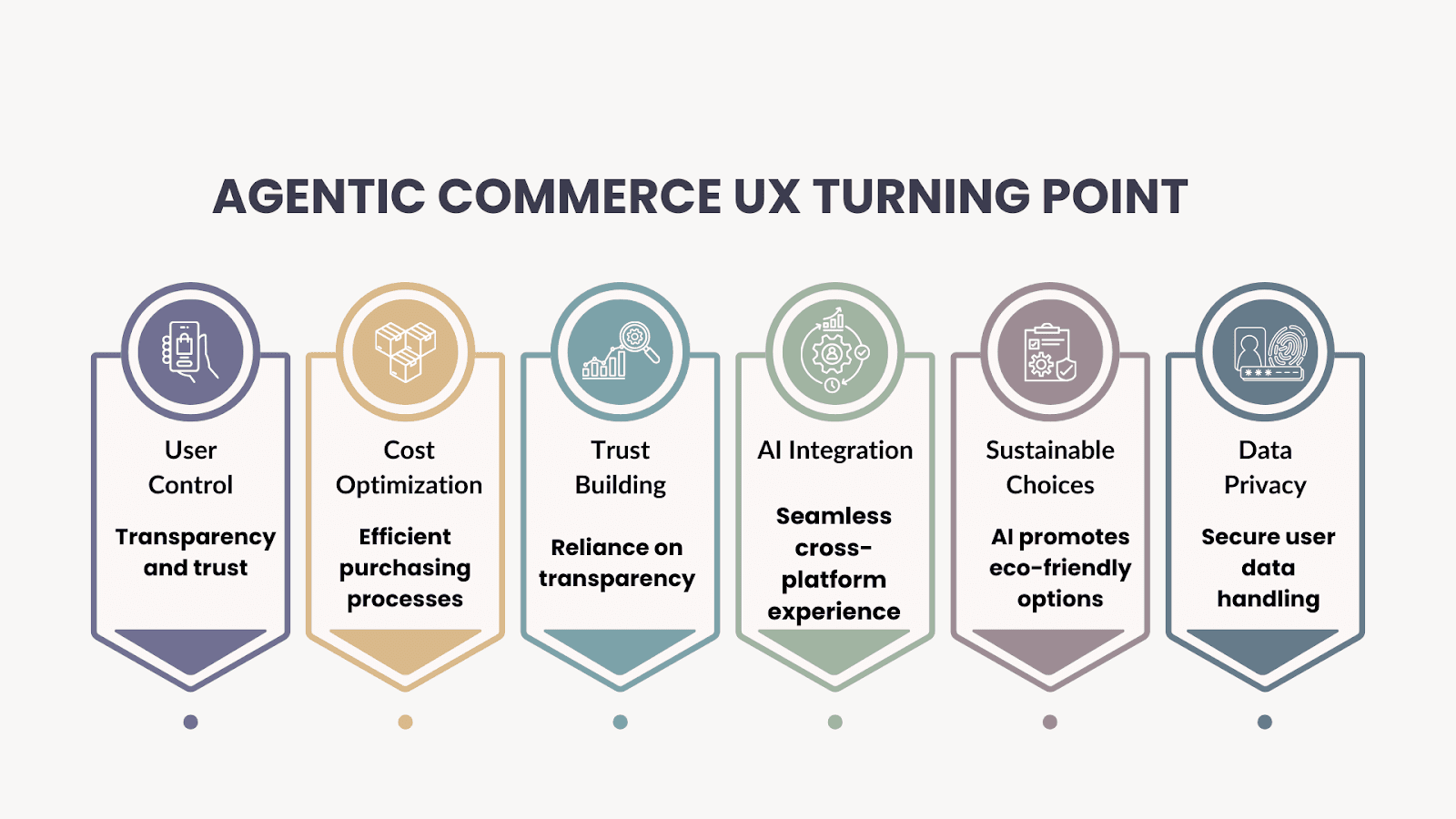
Traditional UX design is built on one core idea: people browse websites themselves. When AI agents begin to search, compare, and purchase on behalf of users, designers must rethink experiences for a world where humans and AI work together.
➡️Humans and AI Agents Share the Journey
The familiar browse → cart → checkout flow starts to fade.
Instead of navigating pages, users express their intent in simple language. The AI agent understands that intent and carries it across systems and platforms to complete the task.
This changes what UX focuses on:
Less emphasis on menus and navigation
More emphasis on understanding user intent
Clear ways to capture preferences and constraints
➡️Interfaces Become Support Systems
In an agentic commerce model, websites are not always the main place where purchases happen. Instead, they serve as reliable sources of information that AI agents can read and use. Discovery, comparison, and checkout may happen inside an AI assistant rather than on a website.
Users step in only when needed:
To review a choice
To make adjustments
Or to approve the final action
Here, the interfaces are support systems that provide clarity, options, and trust.
➡️The Rise of Invisible UX
One of the biggest changes is that much of the experience becomes invisible. Many actions happen in the background, without screens or forms. Because of this, users rely more on trust and transparency than on visual cues.
Users want to understand:
What the AI did
Why a specific option was chosen
What was purchased
And how to change or undo decisions
UX design now includes conversation flow, clear explanations, activity history, and user control. When the interface disappears, clarity and confidence become the most important parts of the experience.
How Agentic Commerce Has Evolved
Agentic commerce represents the next phase of generative AI integration in commerce.
📍According to a 2026 IBM Institute for Business Value research, 45% of consumers already use AI in some part of their buying journey
📍AI agents are expected to handle between $3 trillion and $5 trillion in global commerce by 2030.
📍The same IBM study predicts that nearly half of U.S. online shoppers will rely on AI agents for purchases by 2030, potentially driving around $115 billion in additional e-commerce revenue.
📍Adobe reported a staggering 4,700% increase in traffic driven by AI-powered discovery and shopping experiences, confirming that users are already embracing AI-led commerce paths.
Designing User Experiences for AI-Led Shopping
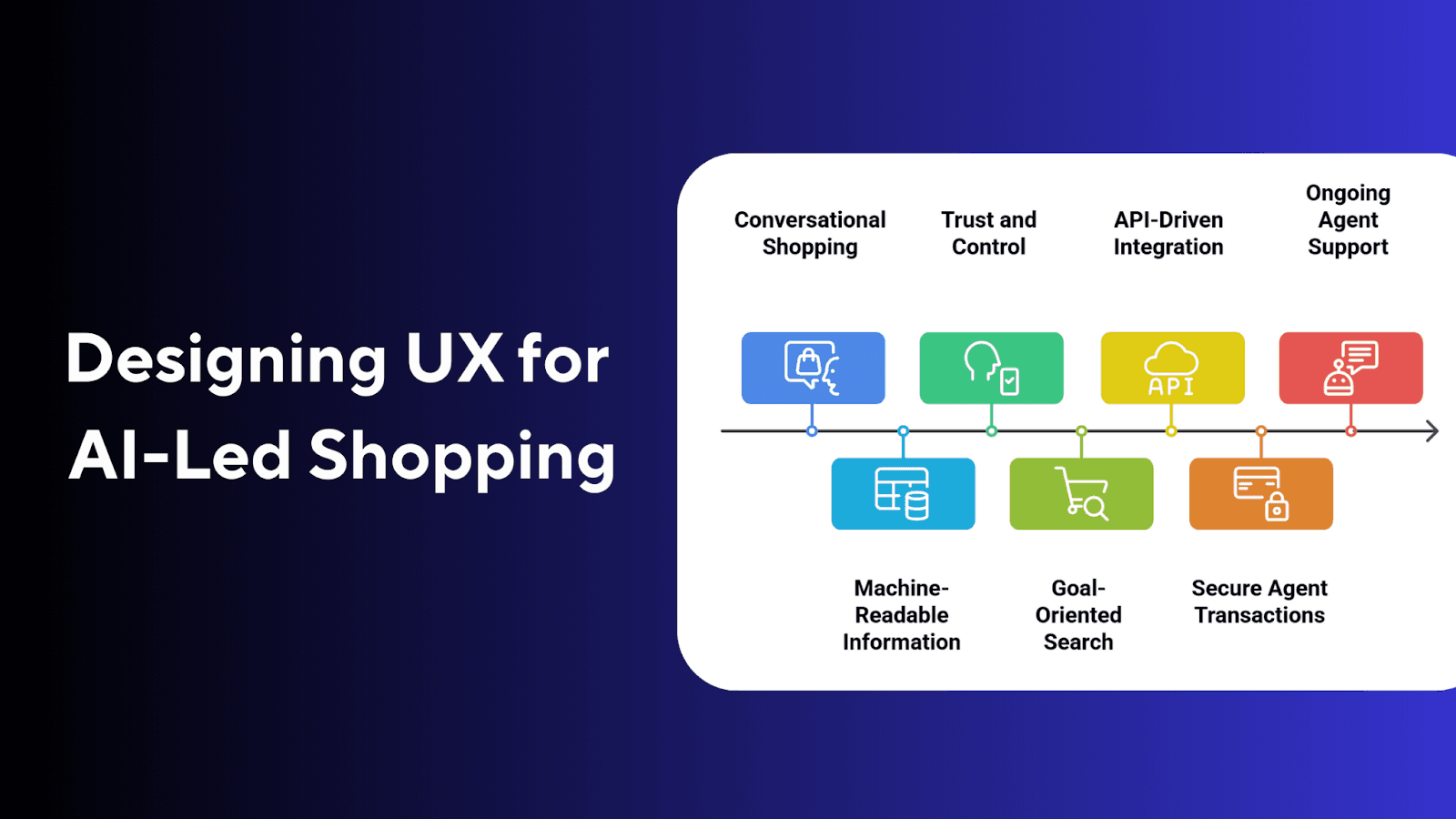
Traditional UX principles like usability, clarity, and visual hierarchy still matter. But the way we apply these principles is changing with agentic commerce. Now, UX helps AI systemsunderstand what users want, take the right actions, and keep users informed and in control.
Let’s dive into how UX is changing to support this new era of agentic commerce, where AI agents shop for you.
a) Designing for Intent: How Users and AI Agents Connect
In agentic commerce, UX starts with intent. Instead of complicated filters, you simply tell the AI what you want:
🔹Your goal
🔹Budget limits
🔹Preferences
🔹Things to avoid
To support this, interfaces will need:
🔹Simple input options that feel like a conversation
🔹Systems that learn your preferences over time
🔹Real-time feedback so you know the AI truly “gets” you
This approach replaces static sorting and endless scrolling with smart, flexible systems that adapt to what you really need.
b) Structured Data as the UX Backbone
In this new model, structured data becomes a core part of the user experience, even though you may never see it directly.
UX designers must work closely with engineers to ensure that product information, pricing rules, and attributes are available in machine-readable formats.
This is similar to schema markup used in SEO, but instead of helping search engines discover content, this data helps AI agents act on it. Without clean, structured data, even the best interface can’t support agentic commerce.
c) Human-Agent Interaction: Building Trust and Control
Users don’t want to sit through long, multi-step flows anymore. They want clarity, confidence, and control.
Good human-agent UX includes:
🔹Showing a clear summary of what the AI plans to do before checkout
🔹Giving easy options to approve, adjust, or override decisions
🔹Explaining why certain choices were made
This approach connects UX design with explainable AI principles. When users understand what the agent is doing and why, trust grows, and the experience feels effortless rather than opaque.
d) Product Discovery Reimagined
For us, product discovery usually means browsing catalogs or scrolling through product lists. For AI agents, however, discovery is about completing a specific goal.
To do this well, they depend on:
🔹Structured product data
🔹Standardized product attributes
🔹Clear and accurate metadata
This is where Generative Engine Optimization (GEO) comes in. GEO focuses on preparing content so AI systems can easily understand it and take action. It builds on traditional SEO and supports AI-led decision-making.
For UX and content teams, this means product pages must be designed as semantic systems. Information should be clear, consistent, and machine-readable. When product data is easy for AI to interpret, discovery becomes faster, more accurate, and more aligned with user intent.
e) Designing for Machines: Merchant-to-Agent Interaction
Agentic commerce depends on smooth communication between merchants and AI agents. This requires:
🔹APIs for product catalogs and pricing
🔹Real-time inventory availability
🔹Clear policies for returns, warranties, and fulfillment
These interactions follow emerging standards called the Agentic Commerce Protocol (ACP).
From a UX perspective, this broadens what we think of as an interface. Design now involves data contracts, schemas, and system behaviors. This means UX and engineering teams must collaborate closely to create seamless communication between AI agents and merchant systems.
f) Trust-Centered Payments and Agentic Transactions
In agentic commerce, payments are handled using secure systems that give AI agents permission to pay on your behalf.
These include things like:
🔹Tokenized credentials
🔹Agent-authorized payment protocols
🔹Embedded checkout within AI platforms
UX plays a key role by ensuring:
🔹Clear permission settings
🔹Risk-based approval levels
🔹Strong user confidence in autonomous transactions
Here, trust goes beyond just security features. It becomes a core part of the design, making the whole payment experience smooth, reliable, and reassuring for users.
g) Post-Purchase UX: Beyond Conversion
The shopping experience doesn’t end once you hit “buy.” In agentic commerce, AI agents stay active after purchase to make your life easier.
After a purchase, agents can:
🔹Track your shipments
🔹Handle returns
🔹Manage subscriptions
🔹Recommend complementary products
On top of that, these agents suggest complementary products that fit your needs, helping you discover useful items without any extra effort.
This means UX design now focuses on the entire customer journey. The true measure of success is creating ongoing value and reducing the hassle for users at every step. When the experience feels effortless and helpful long after checkout, that’s when loyalty and satisfaction really grow.
Challenges UX Teams Must Address in Agentic Commerce
Agentic commerce brings exciting possibilities, but it also introduces real, practical challenges that UX teams can’t ignore.
🔺Data Readiness
AI agents need clear and organized product information to work well. But many stores have messy or incomplete data, which makes it harder for AI to give good recommendations and make smooth purchases.
🔺Trust and Transparency
IBM research shows that 83% of people worry about their privacy and how their data is used. Users want to know what the AI is doing with their information and want to feel in control. UX design has to make these things clear and give users control over the AI’s actions.
🔺Legacy Systems
Most payment and fraud systems were made for humans, not AI agents. This means businesses need to update these systems to work safely with AI. UX teams should include clear permission settings and ways for users to approve or stop AI decisions when needed.
So, how can UX help?
UX designers play a big role here. They need to build experiences that explain what the AI is doing, let users easily review or change decisions, and make the whole process feel safe and simple. This way, people can trust and feel comfortable using AI agents for shopping.
How UX and Web Teams Can Get Ready for Agentic Commerce
To keep up with the future of AI-led shopping, UX and web teams need to make some important changes:
Make product data clear and easy for AI to read. This means organizing information so AI agents can quickly find and understand what’s being offered.
Treat APIs and metadata as part of the user experience. These technical elements directly impact how well AI agents perform.
Update SEO strategies for AI. Create content that AI can both discover and act upon effectively.
Build trust into every AI interaction. Design clear permission settings, transparency, and control features so users feel safe letting AI handle purchases.
Measure success in new ways. Instead of just tracking clicks or sales, focus on how smoothly AI agents complete tasks and how happy users are with those experiences.
By taking these steps, UX and web teams will be ready to create seamless, intelligent shopping journeys that users love.
UX in the Age of Delegation
Agentic commerce raises the bar of UX. When AI agents start making decisions on a user’s behalf, UX becomes the layer that defines trust, accountability, and confidence.
The focus moves from:
How does a user navigate this interface?”
to
“How confidently can a user delegate decisions to an intelligent system?”
This human-and-agent partnership redefines success. It’s about confidence, clarity, and empowering users to delegate with ease.
As we move forward, UX and web design will be less about guiding users through screens, and more about designing seamless, intelligent interactions where autonomy and intention are respected and celebrated.
That’s where UX truly shines.
Design for What’s Next, Without Limits
At Slate, we offer unlimited web design services built for a world where AI agents influence how users discover, decide, and buy. Our design experts craft scalable UX systems that support intent-driven interactions, structured data, and AI-ready experiences.
With our unlimited model, you can continuously evolve your web experience without bottlenecks. From UX strategy and interface design to AI-ready web foundations, we help you move fast while staying future-focused.
Work with us to:
✔️Design UX systems ready for AI-led and agent-mediated commerce
✔️Iterate, refine, and scale without design constraints
✔️Align user trust, business goals, and intelligent automation
✔️Build digital experiences that adapt as technology and user behavior evolve
Whether you’re modernizing your platform or preparing for the next wave of digital commerce, Slate’s unlimited web design services help you design with confidence, today and tomorrow.
Explore our Web Design Expertise → Our Services
Need expert guidance on designing for AI-led experiences?
Design for the future with us → Get in Touch
Disclaimer: All visuals used belong to their respective owners.
Designed for Intelligent Autonomy
Talk to our experts